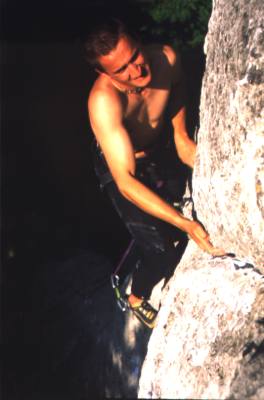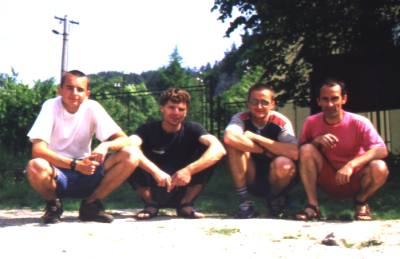
From left: Peter Topercer, Miro Piala, Manu Pellissier a Igor Koller.
Manu Pellissier – representative of FFME
(Jamesák International)
Text and photo by Igor Koller
|
For climbers from former Communist country Czechoslovakia, maintaining good connections among clubs and federations from western countries was essential for the survival of mountaineering, not to mention offering a way for us to climb in alpine areas. Without these exchange trips we would not have been able to climb in the Alps at all. Today, although the political situation is quite different, mountaineering diplomacy remains important.
Thanks to the consideration of the French federation FFME, and above all, Jean Claude
Marmier, current president of FFME, we were able to participate in the last two winter
mountaineering meetings in Chamonix. More contacts are planned. The liaison officer from
the French group is Manu Pellissier, mountaineer and mountain guide, who works for the
FFME.
We met Manu for the first time in Chamonix during the winter meeting of February, 1998. He
took care of all the mountaineers, made all necessary arrangements, offered much advice,
and even managed to climb. We made the final ascent together, climbing the north face of
the famous Les Droites. Manu in spite of the fact that he is relatively young (born in
1974), he has climbed many hard routes all over the world. One can only envy such a record
and see that conditions for mountaineering in France are better than in our country. Here
are some ascents from his explosive climbing career:
- Aconcagua, S face combination of older French routes, 3 days in January, 1994 (age
19)
- Pointe Lepiney, new route, 550 m, 6c+, summer, 1994
- Aiguille des Pelerins, 3. repetition "Beyond Good and Evil", famous mixed
routes of Twight and Parkin, 8 hours, November, 1995
- Patagonia, Aiguille St. Excupery, "Le Petit Prince", 6b+, A4, 700 m, new
route, January, 1996
- Alaska, Mt. Wake, "Tolerant ridge", 5+, 5c, A2, 1500 m, summer, 1996
- member of UIAA expedition in Chola Shan Mountains , summer, 1997
- 2. repetition of Jasper route on Grande Roches , massif of Aiguille Verte, winter, 1998
- new route on Lotus Tower, Canada, May, 1998
- attempt of Jannu N face, Himalaya, September, 1998
- new route in N face of Aiguille de Triolet, winter, 1999
After the February 1999 winter meeting in Chamonix, we agreed that he would come with some French climbers for climbing on Slovak crags at the beginning of summer. He was very busy, but finally, during the last week of May, a small French delegation visited Slovakia. Very small: Manu was the only member.
His entire visit was filled with climbing. At first, with Marek Caltik, they climbed
the Alternative face of Zahorie. He liked the grade 9 routes except for the strange and
different looking bolts. The second day we had a small rest at Pajstun, but the tiny edges
on the Yellow Wall Route destroyed him completely. Grade 8 was for him like a bad joke.
“Easy eight” became the symbol of his climbing trip to Slovakia, as well as a warning
for the climbing days to come. We moved to Manin, where we climbed a classic route with
Fero Piacek. His next partner for other “easy eight” routes on Devil’s Face was Miro
Piala. He liked these routes very much, and Miro as well.
But we have to admit that he appreciated even more our evening discussions by the fire,
with fish and chicken steaks, good beer, good wine, and cigarettes. Fero’s family was
responsible for this part of the trip. Finally, on the last day, we climbed in what is
probably the most beautiful Slovak area - Sulov. Manu claimed that climbing in Sulov was
like Buoux, but the nature more beautiful here.
He left Slovakia very satisfied and with many ideas for the future. One of these ideas is
a big winter exchange. Eight members of the French Junior National Team will come for 2
weeks to climb in the High Tatras, and eight of our climbers will participate in a winter
meeting in Chamonix, with very advantageous conditions for us.
In the meantime, I have sent Manu some question about his experiences in Slovakia, about
his work for the FFME, and regarding the workings of such a large federation.
|
Manu, how did you enjoy your stay in the Slovak crags?
My visit was very interesting. I met friendly and frank people. This is a big contrast to France in some political exchanges.
What do you think about the Slovak climbing areas?
Sulov was my favorite, the mix of towers in such a wonderful nature. I like Manin, as well. I was surprised with the climbing possibilities of these two areas. I have still sore fingers from the “Easy eight” Yellow Face on Pajstun. The routes on Alternative Face were more than average sport climbing.
Could Slovak climbing areas be interesting for French climbers, since you have some super crags in France?
I think that the Slovak climbing areas would be interesting for anyone. But you have to know that there are some runouts, unlike Volx and Orgon.
What did think about the climbers you were with here?
My hero was Miro Piala, with his big muscles and small fear. Marek Caltik is skinny, but a good climber. Fero taught me the Slovak way, how to start a good climbing day with beer and cigarettes at 8:00. I liked to climb with all these guys. In a short period of 4 days I experienced a lot of Slovak climbing.
Why is it interesting for the FFME to participate in an exchange of young climbers?
This kind of exchange is part of our goal to make something useful for young alpinists. This is also a good opportunity for them to travel and exchange experiences. But, of course, it is also good for relations between the Slovak and French federations. Slovak mountaineers participate annually in our winter meetings. This is the reason why we decided to hold the winter course for young mountaineers in the High Tatras, partly because they are hard mountains in winter conditions.
Tell us something about the system of your Junior National Team?
Every two years we choose 9 young climbers between 20 – 25 years old, after one year we select best 6 of them. We provide them with all the necessary alpine gear from various sponsors, and we organize some courses for different kind of climbing, that lasts one or two weeks. This includes a summer alpine course, another dedicated to training, then a course of ice climbing, followed by winter climbing, a course for ski training, an aid bigwall course, a course dedicated to preparing expeditions, a trip outside France (which will be the High Tatras in the year 2000) and finally one expedition. Climbers who pass their exams during the ski course will have not to repeat it during the course for mountaineering guides.
Does FFME support the Junior National Team with money?
No, only gear from the sponsors mentioned above. We do support them partially for expeditions.
How does FFME take care of its sport climbers and best mountaineers?
Sport climbers belong to the Sport Climbing Commission. Regarding the best alpinists, you have good system of national teams. In the future we will probably follow your lead in France.
What prizes to you award the best ascents of the year?
We have the Cristal Award from the FFME for 3 categories: in the Alps, outside the Alps, and the best ascent for young mountaineers up to 25 years old. Five members from the Expedition Commission make the decision.
Tell us something about your work for the FFME?
I work for the Expedition Com, regarding international contacts between the FFME and other federations, I am the director of international meetings and the leader of young mountaineers. I am member of the organizing committee for the Ice World Cup. All this in close cooperation with J. C. Marmierom, president of the FFME. Some years ago, I worked for the federation part time, now it is a full time job. I also earn some money as a mountain guide.
What were your last climbing activities and future plans?
The best of recent activities was our attempt of the N face of Jannu. I was very glad that I survived two avalanches originating from big seracs. During the winter I entered competitions in ice climbing. My best result was 3rd Place in Cortina. In September I lead an interesting UIAA expedition of young mountaineers to Pakistan, in Niallthi. There are still many unclimbed six-thousanders there. In the spring of 2000, we plan the try the N face of Thalay Sagar, and then probably return to Slovakia and try some easy eights or nine.
Manu, thank you very much for your responses and I look forward to meeting you in the Tatras, Chamonix, and on our “easy” Slovak Eights.