|
Maros Sajnoha
What is the UIAA? The UIAA (The International Mountaineering and Climbing Federation) was founded in Chamonix in 1932 as a Federation to group and link Mountaineering and Climbing Associations or Clubs of national importance from all over the World. The JAMES - Club of Tatra mountaineers was one of the founding members.
|
The UIAA's aim is to represent mountaineering global interests, particularly those
problems having an international character. The UIAA also contributes to the development
and promotion of mountaineering on an international level. The UIAA offices are in Berne,
Switzerland. The Bodies of the UIAA include the General Assembly - the supreme legislative
organ - that meets every autumn, and on which each country has representation; the
Council, a restricted group of 19 Associations from different regions that meets twice a
year; and the Board, the executive body. The President of the UIAA and Head of the Board
is Ian McNaught-Davis from London (GB).
The UIAA renders service through its eight Technical Commissions, grouping the leading
experts in their respective fields from all over the world.
These Commissions are: Safety, Youth, Mountain Protection, Expeditions, Medical,
Mountaineering, Competition Climbing, Information and Documentation.
The UIAA currently has 77 members associations from 59 Nations from all continents,
representing several million mountaineers.
Prelude to the event: One pleasant October day the telephone rang
in my flat and Zolo Demjan, calling me regarding the UIAA General Assembly held in Thun,
explained that the structure of the Council was changed and our future activity would
depend on balloting in which there were 8 candidate countries for three last places. The
next information concerned the UIAA 1997 Spring Meeting. India was scheduled to organize
the event, but had canceled in advance. Zolo suggested that I offer JAMES facilities in
Slovakia as a substitute for India. We didn't have enough time to think it over, so I
asked Zolo if he thought we would be able to do it. He answered quickly: Probably, yes.
"Zolo, so offer JAMES as a candidate!" But I had no idea what it would mean. The
next evening, another telephone call, with Zolo's voice of relaying the message: JAMES won
the ballot! We would have representation in UIAA, and the UIAA Spring Council Meeting will
be held in Slovakia. The first thing I realized was that Zolo is a perfect diplomat.
We started in January with preliminary organization and planning. Three months before the
meeting we were required to send to the participants complete information about the entire
program: location, number of rooms for sessions, prices room and board, transportation
information (including flight, train and car connections), program for participant's
partners, fees, names of guides, etc.
The biggest problems were with air transport. Regular flights to Poprad do not exist. The
nearest airport with regularly scheduled service is in Kosice (more than 100 km from the
meeting site). How were we to transport the participants to the meeting location at the
hotel Patria in Strbske Pleso?
Virtually all the participants would be in Slovakia for the first time. Many of them
experienced a natural uncertainty, especially people from the West, about visiting a
former Eastern-Bloc country. Julia Spoerri, UIAA the Administrative Director from Berne,
worried most of all. So we had to answer many daily faxes and phone calls from her. As the
date for the meeting approached, we began to receive calls from other participants, as
well.
Alan Blackshaw, President of the Mountaineering Commission, informed us that he would come
one day early and he did not know how to get from Kosice to Strbske Pleso.
Paola Gigliotti notified us that she would come with her husband and her son and that she
wanted an extra bed. Nico de Jong explained that he would like to stay in the Tatras an
extra couple of days and asked for necessary mountaineering gear. He was perhaps surprised
by our answer: There will be a lot of snow in the valleys. Andre Schoon, from South
Africa, also wanted to stay a few extra days, and he wished to share his room with an
English-speaking partner.
It was not possible to respond immediately to every fax, but we tried from early in the
morning until 9:30 P. M. E-mail is more reliable, but not all of our correspondents had
this miracle, and even Julia Spoerri was not able to contact us through our Internet
address.
We began the process of inviting the mayors of Poprad, Tatra and Strba, and the president
of the Slovak Olympic Committee; Gejza Haak, among others, was chosen as the
mountaineering guide; we started to prepare the bulletin, to visit the studio and printing
company, to prepare welcoming gifts for every participant (since first impressions are
very important!). CSA agreed to arrange for bus transport from Kosice to Poprad for the
flight arriving at 12:55, but there are no bus connections for flights arriving at 14:50
and 22:55, so Peter, Marika and Gabika (employees of the Trade Company Krokus) thought
quickly to provide a solution to this transportation problem.
But, alas, everything must work perfectly: What restaurant to select for the Gala dinner:
Koliba in Smokovec or in Tatranska Lomnica? (Does everybody have a suit?!) What about
money? We would need more than 100 000 SKK from the beginning, but we did not want to
spend money already designated for other JAMES purposes. We had trouble finding sponsors,
who were reluctant to help. After all, they surmised, this is not a meeting for the
Olympic Games, or a World Championship; there would be no TV coverage for a meeting of
mountaineers. But for us in JAMES, we knew that for the first time in history
representatives of the UIAA from all over the world would visit Slovakia, many of them for
their first time, and they would come with a little anxiety about how this meeting would
occur (we had the same fear), and finally, after they leave our country, what would they
say about JAMES, the High Tatras and Slovakia.
Finally May 1st arrived. We had done all we could, and one day before the meeting we set
off with Milan to Strbske Pleso. Just before our departure, Professor Cernusak had to
cancel his presentation, which we had announced to the UIAA office. But this was only the
first shock. The next one came with a message from Krokus. Gabika informed us that half of
the participants (who were scheduled to land in Kosice at 12:55) did not make the
connection in Prague, so they would now arrive at 14:50, with no bus transport to Poprad.
"You know, Mr. Sajnoha", she explained, "I only wanted to check on the bus
and they told me that they had no such travelers, so I changed that bus from CSA in Poprad
to Kosice and they will pick them up at the airport, OK?"
Cute Gabika!
The Event But that was not all. The next shock came just after we
arrived at the Patria. All the fax and telephone numbers for the hotel had been changed.
Of course, we had given out the old numbers to everyone. To make matters more complicated,
there was no English or Slovak message to explain this change, only a sound from the
telephone to indicate a non-existent number. Now we were close to having a heart attack,
especially when a woman from the hotel whispered ruefully: "They promised an
answering machine, but they didn't bring it." So we waited with Kazo, Zolo and Milan
in the entrance hall for participants to begin to show up - with big beers to pass the
time, of course. Mr. Moon from South Korea came first. Shortly, the president of the
Information and Documentation Commission, Andre Stoop, from Belgium, arrived and just
behind him came Nico de Jong from Holland, who was soaking wet from his trekking boots up
to his knees. He made the trip to Rysy before coming directly to join our group in the
bar.
There were pleasant greetings from everyone, and Zolo bought a round of beers. After a few
minutes, Mr President became simply Andre, Mr de Jong became Nico, etc. Polite words were
changed into hearty smiles.
I said, "Nico, you have become wet." He proceeded to tell me with a smile that
he had called the JAMES office for information and that someone there had replied that
there was a lot of snow. "That was me," I explained, "and I also suggested
that you to bring your skis." "That was you?" Nico said smilingly.
"You said: snow, snow, snow, but I thought that you couldn't be serious." We
began teasing Nico, and soon all the barriers had fallen, and with them my anxiety. I
realized that these guys were just regular mountaineers. Andre inquired about Zulo from
Green Lake Chalet. "Zulo, Zulo? Yeah, you mean Julo, our barman from the chalet, who
often acts like our good mother sometimes with lot of advice." I asked Andre how he
knew Julo? "I was there twice," he answered. "He is a nice guy."
After the arrival of the bus from Kosice, with almost all of our previously lost
participants, we forgot about all our old problems. The meeting had started without
mistakes. Our engine began running perfectly, at just the right temperature and the proper
rotation.
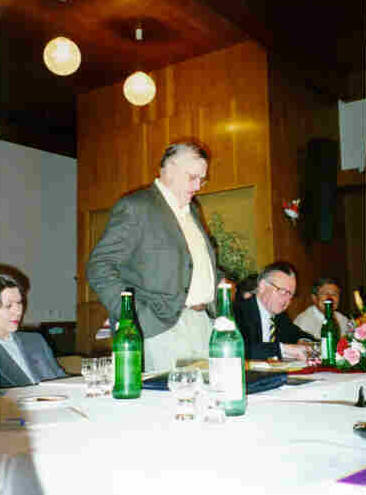
The next problem point was dinner. According to the program, only members of the Board and
presidents of Commissions were invited. We found to our dismay that all 40 participants
were waiting to sit in 24 chairs, with only 24 glasses of borovicka. I appreciated that
these 40 mountaineers were all smiling, but I especially appreciated the restaurant staff,
also with smiles, promptly finding another 16 chairs. Although the solving of the chair
problem ended up with my "personal translator" (Kazo) finding a seat far away
from me, and for two hours I was left to speak in English with the President of UIAA, Ian
McNaught-Davis (in a short time he was Mac) and other representatives. I managed to tell a
few jokes, and they laughed, although I am not sure whether they were laughing at the
jokes or my English, or maybe both.
The meetings of the Board and of the Presidents of Commissions were private, but Zolo,
Kazo and I participated in the day-long Council session on Saturday. In his invitational
speech, President McNaught-Davis thanked JAMES for perfectly organizing the meeting. Then
he surprised us by perfectly explaining the "marmalade" history of our name
JAMES, in which each letter stands for a special word.
We discussed many different topics: changes in UIAA membership fees, the idea of choosing
a new name for the UIAA (since alpinism is not an appropriate word for a wide range of
mountaineering sports), information about the foundation of an Asian Alpinist Union
regrouping 35 states. There was a long debate about the cooperation between the Council
and the Presidents of Commissions. The Safety Commission, which together with the BMC
monitors mountaineering accidents, informed the meeting about its results, including the
important fact that the total number of mountaineers rises annually, while accident
statistics remain the same. This is one result of the Safety Commission's work. There was
a major discussion regarding safety standards for climbing gear between the UIAA and
European CEN norms. The Safety Commission is able to certify a product with the UIAA label
within six months, but in order to obtain a CEN standard may take up to two years. In two
year's time a "new" product may be out of date.
In 1995 the International Olympic Committee IOC has granted outright recognition to the
UIAA as a Recognized member Federation. In its capacity of IOC member, the UIAA is now
working towards obtaining programme status for the sport of competition climbing within
the Olympic Games. The Council discussed the strategies to be pursued in order for
competition climbing to become an Olympic discipline in one of the future Olympic Games.
The Medical Commission formulated four main activities. The Expedition Commission had
managed to negotiate lower fees for mountaineers in Chile from $850 to $100 per person.
The Mountaineering Commission explained its work on a common methodical program involving
model training standards for voluntary leaders and instructors with the goal of providing
international accreditation to associations that meet with the criteria.
The Youth Commission presented a report on the international youth meeting and a program
for indoor competition for children more than 5 years old. The Information and
Documentation Commission introduced a program for the coordination and exchange of
information among info centers of individual associations (JAMES has its own Information
and Documentation Center, for example).
Of course, due to space restrictions, I am not able to discuss in detail all the issues
raised during the Council Meeting.
Gala Dinner The official farewell dinner was held at the Koliba in
Tatranska Lomnica. But there happen to be two Kolibas in Lomnica, and the bus unloaded its
well-dressed ladies and gentleman in front of the wrong one. The bus disappeared and, to
our good luck, our mountaineers took the 20 minute trek to the right pub in a very good
mood. They must have been in a really good mood, because when we returned to Patria at
close to midnight, with hands full of nice presents, no one headed for the room; instead
they turned to me expecting advice about the rest of the "program."
So we continued our "special program" at the local Vatra bar. Later, as I danced
in the light of dawn to the rhythm of disco music, I managed to get close to Zolo and
shouted: "Do all UIAA Council meetings finish this way?" To which he shouted a
reply: "In all my 8 years with the UIAA, this is the first time."
What to say in the end? The Great Wall of China was intended to be a protection, but it
became a fence of isolation, and then a barrier containing decay. This is why we want to
be open to the world, to communicate and be helpful to others. Organizing the UIAA Council
Meeting was for us a chance to show ourselves as JAMES, Slovakia, and hopefully to show
some of our abilities.
I think that the abilities of JAMES are not too bad: they came as strangers and they left
as friends.
If for no other reason, it was a big success!