|
Vlado Linek
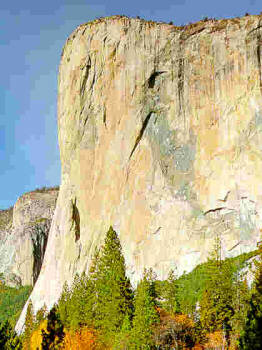
From my beginnings as a climber, the word Yosemite created in my imagination a perfect image of huge granite walls, hard aid routes, impossible bouldering problems, and the climbing paradise supposedly to be found in the infamous barbarism of Camp IV.
|
I first saw a photo of El Capitan's south face in the magazine, The World
of Socialism, in 1983. At that time, Jaryk Stejskal, a member of the Czechoslovak National
Climbing Team, was on a trip to the USA with his Australian friend, John Howard, to climb
El Capitan via The Nose's 1000-meter crack route. The photo was of Jaryk hanging in aiders
900 m above the ground, with a huge nothing below. At that moment, El Cap moved to the top
of my (still-virgin) dreamer's climbing agenda.
There were a few problems. One was more extensive climbing experience. Another was a
paternalistic totalitarian system of government that wanted to protect us from being
corrupted by the evils of America by refusing to let us travel there. But I found that the
Tatra mountains, limestone promontories and castle-topped crags of Czechoslovakia were
fine places to train and gain the necessary experience; and while I was training,
Communism was self-destructing.
Finally, in 1994, with foreign travel now limited only by visa demands and money, this
idea was miraculously reborn when my friend Martin Heuger said only by chance that he
would eventually go to the USA to climb the rocks of his dreams. Soon we were four. Oto
Bajana and Boulder Kristin from the same climbing club (Filozof Bratislava) expressed
their desire to join us; we chose late summer of 1995 as a target date, then tried to
figure out how we'd pay for it.
In August, 1994, during Traditional Mountaineering Week, held annually in the High Tatras,
I mentioned our plans to American climbers Holly, Judy, Don and Jeff, who are also mem-
bers of the Slovak Mountaineering Union, JAMES. They promptly promised to help us.
We had to arrange for extended leaves from our jobs, then put all our coins together, but
the biggest problem was to get US visas. We gathered up everything required and waited in
a four hour queue in front of the American Embassy in Bratislava, in order for Mrs.
Embassy Person, who was very strict, to inform us that maybe only 25 % of the applications
were successful.
"But," I said, "I am the leader of the first Slovak mountaineering
expedition to California." "OK, have a good time," she answered. That
afternoon we received visas valid for two years. We left in September, after a moment of
panic at the Vienna airport. I had a climbing hammer in my personal luggage and X-ray
found it. The hammer was confiscated with the explanation that it is forbidden to hammer
pitons inside a British Airways plane. After I promised that I would not place any pitons
inside the plane and we would not climb on the fuselage, we (and my hammer) were allowed
to board, and we flew west into the dreams of four young Slovak climbers.
By that time, Holly and Don had decided to live in Slovakia for a while, but Judy and Jeff
met us in Los Angeles and took us to their "home" (a sailboat) in San Diego.
They helped us orient to the country, took us shopping for supplies (Martin decided that
48 Snickers bars would be helpful in Yosemite), and after some touring that included pub
crawling in Tijuana, where we learned about a wonderful tradition called "tequila
shooters," we set off for paradise.
We came into the park at sunset from Lee Vinning, and suddenly I saw it: There was El Cap.
It was like Christmas tree; headlamps shone everywhere. It took me back more than a
decade, to a young man's impossible dreaming over a photo in a Socialist magazine; the
world had changed so that I could see this, so that I could touch this magnificent rock. I
have seen many big walls in Europe, but this one was mine. I had held it close in my mind
for a very long time.
At 9 PM, we stopped in front of Camp IV, a Mecca for climbers from the whole world. We
were a little bit embarrassed because there was a sign saying the camp was full and we had
not considered an alternate. We decided to sleep close to the camp, as many climbers did,
and to wait for Rangers the next morning. Then more experienced climbers told us that the
sign was always there, and that there were enough places for us. We found a place to pitch
a tent, although what Jeff called a tent would in Slovakia work fine as an Army barracks.
We had never seen such a massive and luxurious tent, not to mention complex. Luckily we
are all educated and finally conquered the instruction book.
We spent the first few days exploring and bouldering, and the nights scaring away hungry
cousins of Yogi Bear. Then we decided to increase our scope and selected the Chapel Wall,
anxious now to warm up on Yosemite cracks.
First, we tried Gold Dust, rated 5.10d. We met our Waterloo there, wondering if we would
have to lower the scope of our assault on Yosemite valley. A difficult route with
strenuous friend placements lowered our usual on-sight ability one grade down. While we
sat moping and chastising ourselves, a nice woman began climbing close to us. We watched
her easily climbing a 5.12 route and chose her as our inspiration. She introduced herself
as Sue from Yosemite. Later we learned that she is the only female professional climbing
guide in the area, and a virtual inventory of Yosemite climbs.
Jeff's Alaska friend, Tim, joined us and we began training in earnest for The Nose. Jeff
and Tim started climbing together in 1968 in Yosemite, after they had returned from the
war in Vietnam, so this was also a reunion for old friends. The next ten days blended
together as we climbed as much as possible. Cookie Cliff, 100-meters high, was our
favorite training crag. We decided that the best preparation for The Nose was to alternate
short routes with longer ones. Many of these "training" routes were memorable
themselves. I will never forget The Good Book on The Folly, especially the 35- meter
overhanging layback on the third and hardest pitch. During the first attempt I was not
able to climb it in one push. I suffered from the fear that comes from not trusting the
Friends, on which I was not used to placing so much dependence, and the fear sapped enough
of my confidence that I couldn't complete the route successfully.
After a three day break we tried this route once more. I was in better shape and could
climb close to my limit. But pushing the limit resulted in a 10-meter fall, the positive
result of which was that I learned that your best friends in Yosemite cracks are Friends.
Oto and Martin tried to climb Astroman on Washington Column, but they were not able to
finish before dark and had to rappel down. Together with Oto and Tim, we climbed a five
pitch route - the Central Pillar of Frenzy on Middle Cathedral Rock. Tim, who had not
climbed for 20 years, impressed a bunch of Slovak climbers as he struggled but survived an
impressive route with only a few small problems. Oto, our crack specialist, tried
Controlled Burn, 5.11a, on The Chapel Wall. Hoping to get some action photos, I climbed a
nearby tree and watched Oto's gymnastics. But only three meters below the top of this
route, Oto stopped and was unable to continue. Having not yet learned to trust his Friends
in Yosemite cracks, he was too afraid to climb up and it was too difficult to climb down.
He called out to me that he wished it was possible to fall up. But wishing does not change
gravity. Boulder and I went to his rescue. First we tried to toss a more
appropriately-sized Friend up to him, which ultimately failed. Then Boulder decided that
we could climb an easier route to the right and throw him a rope from the top. Oto
completed the route on a top rope in 10 seconds, then had the guts to tell us that it was
easy.
Because Jeff and Tim would have to leave us soon, we decided to climb together a big wall
route that required less commitment than The Nose. Our choice was Northeast Buttress on
Higher Cathedral Rock, 12 pitches. We woke up at 5 AM. We had an ominous beginning by
losing our way in a dense forest on the approach. Then Boulder stayed back to, as we say
in Slovakia, take a "peristaltika," and got more lost trying to find us after he
finished. So we had to abandon our approach in order to find Boulder.
It was 9 AM when we reached the base of Higher Cathedral Rock, and there were already two
climbing teams in front of us: two girls from Germany and a team from LA. We had to wait
another hour before we could start climbing. After three pitches, Jeff and Tim decided to
rappel down, so only Boulder and I continued. In the middle of the wall, on a large ledge,
we sat down, made ourselves comfortable, and watched the progress of the two German girls,
then on the hardest pitch. They were groaning and complaining loudly, and we made a number
of unflattering comments. After two hours waiting for them to move out of the way, it was
our turn. The pitch is rated only 5.10, but the last five meters follow a poorly-
protected off-width crack. After some hard climbing, we decided we had been a little hard
on the German girls. Still three pitches below the top it was getting dark. We decided to
rappel down and not to bivy there. By the time we reached the main road it was as dark as
pitch, and in the darkness we got turned around, setting off in the wrong direction. After
half an hour of hiking we figured out that we were going the wrong way and turned back. We
started hitch-hiking and at once somebody stopped for us, but not only one car, six cars
stopped together. Jammed inside the cars were about one hundred people from Puerto Rico.
We don't know why they stopped, because they seemed at first to be afraid of us and close
to panic. After explaining, that Boulder was not a policeman, they continued, but without
us. Eventually we got a ride back to Camp IV and our new traditional way to spend the
evening - protecting our food from Yogi and his mad bird friends.
Finally the time came to try The Nose. We intended to climb The Nose in three days and
packed six litters of water (two litters per day), six Powerbars and couple of sponges
(which is what Americans call slices of bread) per person. We added some paper bags for
portable toilets, and of course, our climbing gear. We started the approach at 2 PM. Our
packs were heavy, but not so heavy that it would be necessary to crawl up the approach. We
were not real bigwall rats, because we had no big kitchen stove, golf clubs and tape
recorder, but we came across such climbers, including a pair of rats carrying more than
twice the stuff we had for four. We started to climb at 3:30 PM. Our goal was to reach
Sickle Ledge (four pitches) and to sleep there. We climbed in two teams, Oto with Martin
and me with Boulder. From the very start, the first pitch proved to be difficult and
scary, with bad protection. It was necessary to place all the protection ourselves, with
our own gear. We had no hauling bags and no pulley, so our progress was slow. By sunset we
finished the third pitch and rappelled to the ground. The next morning found us again in
the wall. At 9 AM we were close to Sickle Ledge, where we came across a bad sign, a fixed
rope. All of sudden this rope began shaking like a snake and we saw a South Korean climber
jumaring up. We watched him reach Sickle Ledge, then another, then another, until after
half an hour there were seven of them. It was big Korean expedition. Jumaring, they
overtook us. The leader had about 200 Friends, but no climbing shoes; they climbed every
pitch on aid. We had to wait almost 7 hours on Sickle Ledge for them to get out of the
way. That evening we fixed the next three pitches to Stovelegs Crack, then returned to the
ledge. The Koreans thought we were crazy for trying to climb free.
We spent the night on that oblique ledge and thanks to Oto's snoring, we didn't get much
sleep. Then, at 5 AM we heard a terrible noise.
"Oh, it's an earthquake," I thought, before realizing that in spite of the
terrible, loud noise, the ledge wasn't shaking. Then I heard screams and a stream of bad
words. At that moment I saw the parachutes rushing by as five BASE jumpers descended
directly in front of us. We watched them land close to the road, jump into a car and
quickly disappear. After that wake-up call, we took down the belay and began climbing
again. In one hour we reached our previous high point and started to climb Stovelegs
Crack. That part of the Nose was amazing, as well as a little bit scary because we lacked
an adequate supply of large Friends. This was crucial when we reached the last pitch below
Dolt Tower. Our crack specialist, Oto, finally climbed it and the rest of us were lucky to
finish on a rope from above.
In spite of good weather and pleasant climbing conditions, a new problem loomed in front
of us: we were well on the way to achieving our goal, but we had run out of water. We had
only brought water for one day, because we were sure we could reach the top in that time.
We had not counted on sitting around most of a day on a ledge watching a flock of Koreans
in tennis shoes jummar up our route.
Then our prayers to the climbing gods were miraculously answered when we found by chance
on Dolt Tower about 20 liters of water squirreled away in a crevice. By dawn we reached El
Cap Tower. This tower is a super ledge designed for sleeping; it is horizontal and one and
half meters wide. The next morning we joined our two teams into one because of a shortage
of Friends. We had a leader, belay-slave and two haulers. That morning we passed Texas
Flake, Boot Flake, and the big pendulum, King Swing. At 3 PM, Oto started to climb The
Great Roof, the first of two pitches rated 5.13b. Boulder and I waited at Camp IV. About
this time, a team from Switzerland reached our ledge. It was certain that they would not
be able to climb to Camp IV that day, so they pitched a porta ledge and started cooking.
Their dinner consisted of five courses. In our fourth day of fasting, we could only watch
and slobber. By dusk, Oto reached Camp V. We finished jumaring at 11 PM and prepared for
our last bivy on the wall. Boulder had the "best" spot on the bivy ledge, and
his legs hung out in space. I did not sleep at all. My nerves were shot and I was watching
the moon all the time. I hoped that the next day we would be able to finish the next ten
pitches and reach the top.
Our fifth day on the route: Glowering spot, a technical pitch, belonged to Martin. The
30th pitch is the second one rated 5.13b, but for us it was aid climbing from Friend to
Friend. Then our progress was again halted by the Korean expedition.
The last pitches were the most beautiful I have ever climbed: Gorgeous cracks, catchy
laybacks, paradise almost 900-meters above the ground. It was my turn to climb the next to
last pitch. (Martin was to have the lead on the last pitch.) It was mostly aid climbing
protected by new bolts through the huge overhang. At the last belay I remembered the
descriptions of other climbers I had read about this place. I was overwhelmed by the view
and the beautiful sunset. Martin broke my contemplation and pushed my heart into my throat
by telling me to climb on to the summit.
At 8 PM, in 50 hours of real climbing and three bivies on the face, we left the nose of El
Cap and stood on the top. My old dream, born from a black and white photo in a Socialist
magazine, was fulfilled. Now I had pictures of my own. We slept on the top. In the morning
Boulder and Martin took some photos of their own. We only had climbing shoes and to avoid
a seven hour walk down in them, we went barefooted, including during four rappels. We
reached our car at 3 PM. Following a feast that seemed to have no finish, we spent the
night below El Cap so that in the morning we could pick up the waste we had thrown from
the wall.
Soon we would be forced to leave the magical valley and return to Slovakia with our
pockets empty of money but full of memories and pictures. For our last day we wanted to
climb something special. Local climbers recommended Serenity crack with a combination of
Sons of Yesterday. It was superb advice, because this route was, I think, the most
beautiful that I climbed in Yosemite. To hear Boulder screaming about excellent jamming
was a rare experience. We had become accustomed to crack climbing, and were no longer
afraid to climb a couple of meters above the last Friend. In three hours we reached the
top of this 8 pitch (one place rated 5.10d) Yosemite jewel.
The last day of the dream: We had a last view to El Cap and Half Dome from the parking
place in front of the Wawona Tunnel. We had spent one month of our lives in the valley and
had participated in a miracle: We had climbed in Yosemite. Four Slovak dreamers had
climbed The Nose.